A TALE OF TWO HOLES is an immersive audiovisual collaboration that responds to two distinct petro-disasters as entry points into geologic time and the language of earth science—from planetary-scale climate engineering to the study of subterranean formations. Though separated by over a decade and thousands of miles, these episodes expose how the vocabulary of geoscience absorbs acute, human-caused crises into unfathomable scales of deep time and space, effectively neutralizing the industrial and military violence at their heart.
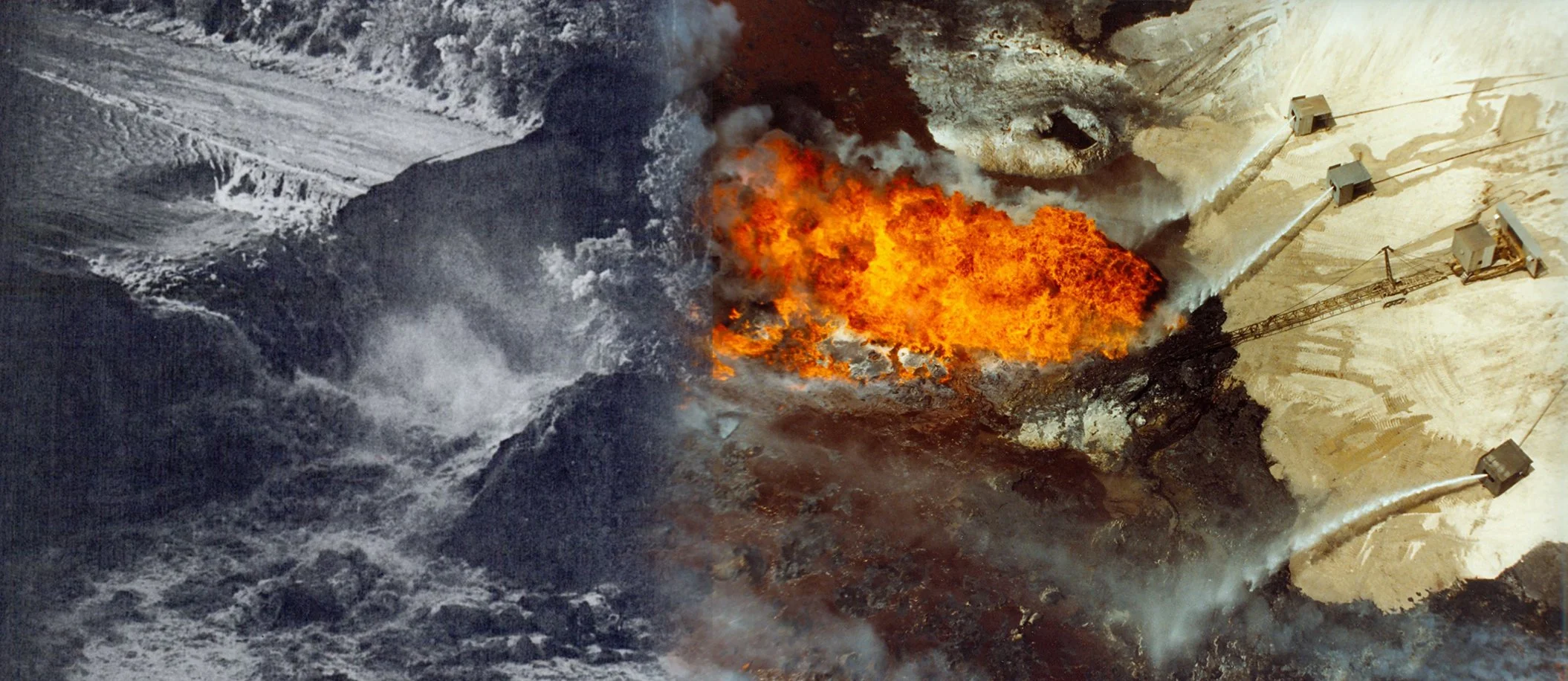
FIRST HOLE – The Earth, Explicated
As the Iraqi military withdrew from Kuwait in January 1991, under US attack, it set several hundred oil wells aflame. The fires were exquisitely difficult to extinguish. Kuwait’s oil fields continued to burn for several months, producing enormous clouds of smoke. And as they burned, North Atlantic scientists began to discuss this unfolding episode in scorched-Earth warfare as a de facto experiment in cooling the Earth’s atmosphere—that is, as an inadvertent trial with what is today known as geoengineering. Could so much smoke, they asked, deflect enough solar radiation to cool the planet? Might it ultimately teach North Atlantic institutions how to control and manage that process on behalf of “humanity”?
“The Earth, Explicated,” revisits the oil fires and their mediations in planetary science, international law, and aesthetics to explore the encounter of humanitarian war and planetary technoscience. The United States’ destructive adventures in the Arabian Gulf did not merely degrade the global environment—they shaped enduring notions about how the Earth “works,” and what it means to “intervene” in a planetary crisis.
SECOND HOLE – Mister Joe’s Cow
The planetary scale of the first hole is inverted by descending into a singular, violent rupture: The Lake Peigneur disaster of 1980. After a Texaco oil rig punctured a subterranean salt dome in southeast Louisiana, the lake drained into a massive vortex, collapsing the mine, and swallowing the oil rig, residences, and acres of land that were the former cow pastures and a sugar plantation in a matter of hours.
A collection of microscopic images of halophilic bacteria, hydrophone recordings from the reformed lake, and archival imagery pivot away from anthropocentric tales of industrial error. The spectacle of cows swallowed by the earth is not an endpoint but a fulcrum of scale, collapsing the human timeframe of sugar plantations, cattle, and oil rigs into the time of a Jurassic salt deposit—a moment when the Earth's interior void became catastrophically visible.
––––
Cameron S. Hu is a Mellon Postdoctoral Fellow at the Center for the Humanities at Wesleyan University. His research focuses on technoscience, capitalism, war, and the geopolitics of the planet. His current projects include: Planet Texas, a global ethnography of the US fracking revolution; Epistemania, a critical genealogy of contemporary ideologies of "knowledge production"; and GeoLiberalism, an historical anthropology of liberal war and planetary science in the 1990s.
Robin B. McDowell is Assistant Professor of Environmental Studies at Bates. Her work explores historical dimensions of environmental racism in south Louisiana wetlands, sugar plantations, oil fields, and salt mines. Her first book project, Black Bayou: Race, Ecology, and the Transformation of Louisiana Wetlands, draws on archives, oral histories, earth sciences, and multimedia art making.